

Our Blog
Latest trends, research, and updates across everyday productivity tech tools.
Our Blog
Latest trends, research, and updates across everyday productivity tech tools.
Our Blogs



The ROI of IT Consulting: When Should Small Businesses Hire Outside Experts?
The ROI of IT Consulting: When Should Small Businesses Hire Outside Experts?
In today's competitive business environment, technology is no longer just a support function. It is a strategic asset that influences productivity, customer experience, operational efficiency, and profitability. Yet many small and medium-sized businesses (SMBs) struggle to determine when they should invest in professional technology guidance.
The reality is that many business owners spend thousands of dollars on software subscriptions, digital tools, and internal technology initiatives without a clear roadmap. The result is often duplicate systems, inefficient workflows, security vulnerabilities, and missed growth opportunities.
This is where IT consulting for small business becomes a game changer. Rather than reacting to technology problems after they occur, smart businesses engage experienced consultants to align technology investments with measurable business outcomes.
But is the investment worth it?
Let's explore the true SMB tech consultant ROI, how to identify when outside expertise is needed, and why partnering with a trusted advisor like KD Squares Services can create lasting value.
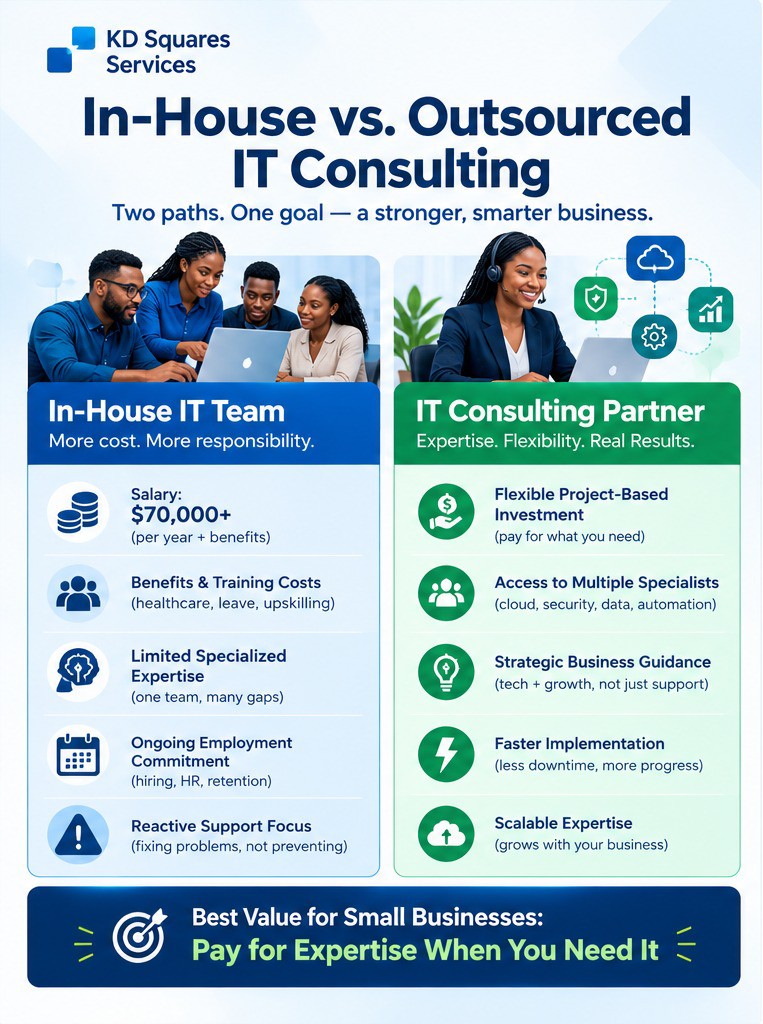
In-House vs. Outsourced IT Consulting: Making the Strategic Decision
Every growing business eventually reaches a point where technology decisions become more complex than internal teams can comfortably manage.
While hiring full-time IT staff can make sense for larger organizations, many SMBs face a different reality. Maintaining an experienced in-house technology team requires significant investment in salaries, benefits, training, certifications, and management oversight.
The Advantages of In-House IT
An internal IT employee can:
Provide immediate support for daily technical issues
Understand company culture and internal processes
Be available for ongoing operational needs
Maintain direct relationships with team members
However, internal teams often have limitations.
Many businesses rely on a single IT generalist who may excel at troubleshooting but lacks specialized expertise in strategic planning, cybersecurity, automation, cloud infrastructure, data analytics, or digital transformation initiatives.
The Advantages of Outsourced IT Consulting
External consultants bring broad experience gained from working across multiple industries and business environments.
They can:
Identify technology gaps quickly
Recommend proven solutions
Avoid costly implementation mistakes
Provide objective assessments
Deliver specialized expertise on demand
Accelerate technology projects
Perhaps most importantly, consultants focus on outcomes rather than maintenance. Their goal is not simply to keep systems running but to ensure technology actively contributes to business growth.
For many SMBs, outsourced consulting provides access to enterprise-level expertise at a fraction of the cost of hiring multiple specialists internally.
4 Critical Scenarios Where External IT Expertise Pays for Itself Instantly
While not every business requires ongoing consulting services, there are several situations where hiring an outside expert generates immediate returns.
1. You're Investing in New Software
One of the most common technology mistakes small businesses make is purchasing software before fully understanding their requirements.
Business owners frequently buy:
CRM systems
Accounting platforms
Project management tools
Marketing automation software
Inventory management systems
Without proper evaluation, organizations often discover that the software lacks critical features, duplicates existing functionality, or creates integration challenges.
A qualified consultant can assess your operations, identify requirements, compare options, and prevent expensive purchasing mistakes before they happen.
The savings from avoiding just one poor software investment often exceed the entire consulting fee.
2. Your Team Is Spending Too Much Time on Manual Processes
Manual work is one of the largest hidden costs in growing businesses.
If employees are:
Re-entering data across multiple systems
Managing spreadsheets manually
Sending repetitive emails
Generating reports by hand
Processing approvals through disconnected workflows
Your organization may be losing hundreds of productive hours annually.
This is often the moment when companies decide to hire a business automation consultant.
Automation specialists identify opportunities to eliminate repetitive tasks, connect systems, and streamline workflows.
The result includes:
Faster turnaround times
Reduced human error
Greater employee productivity
Lower operational costs
The increased efficiency often delivers measurable ROI within months.
3. Your Technology Costs Keep Rising Without Clear Results
Many businesses experience "software subscription creep."
Over time, teams independently adopt new tools to solve specific problems. Eventually, the organization may find itself paying for:
Multiple communication platforms
Duplicate project management systems
Unused software licenses
Redundant reporting tools
Overlapping cloud services
The monthly cost might seem manageable, but the annual impact can be substantial.
An experienced consultant conducts a comprehensive technology audit, identifies redundancies, and recommends consolidation strategies.
Businesses are often surprised to discover significant savings opportunities hidden within their existing software ecosystem.
4. Security Risks Are Growing
Cybersecurity is no longer a concern reserved for large enterprises.
Small businesses are increasingly targeted because attackers often assume they have weaker defenses.
Common vulnerabilities include:
Poor password management
Unsecured cloud environments
Lack of employee security training
Outdated software
Insufficient backup procedures
A single security breach can result in financial losses, operational disruption, reputational damage, and regulatory consequences.
External consultants help identify vulnerabilities before they become costly incidents.
In many cases, the prevention of even one security event can justify the consulting investment many times over.
How to Audit Your Current Software Stack for Hidden Waste and Redundancy
One of the fastest ways to improve technology ROI is to evaluate your existing software environment.
Most SMBs are paying for tools they don't use fully or need at all.
Step 1: Create a Complete Software Inventory
Start by documenting every software application currently used across the business.
Include:
Subscription costs
Number of users
Primary functions
Renewal dates
Department ownership
Many organizations discover they have far more applications than expected.
Step 2: Identify Functional Overlap
Review whether multiple tools perform similar tasks.
For example:
Two project management platforms
Multiple file-sharing systems
Separate reporting tools pulling identical data
Duplicate communication applications
Consolidating platforms often reduces costs while improving collaboration.
Step 3: Measure Actual Usage
Paying for software does not mean employees are using it effectively.
Evaluate:
User adoption rates
Feature utilization
Login frequency
Workflow dependency
You may discover licenses that can be eliminated or downgraded.
Step 4: Assess Integration Quality
Technology should work together seamlessly.
Ask:
Are employees manually transferring information between systems?
Is data duplicated across platforms?
Do reporting processes require manual intervention?
Poor integration creates hidden labor costs that rarely appear on financial statements.
Step 5: Compare Technology Against Business Goals
The ultimate question isn't whether software works.
It's whether software supports strategic objectives.
Consultants often uncover scenarios where businesses own powerful tools yet fail to leverage their most valuable capabilities.
Aligning technology investments with business priorities dramatically improves returns.
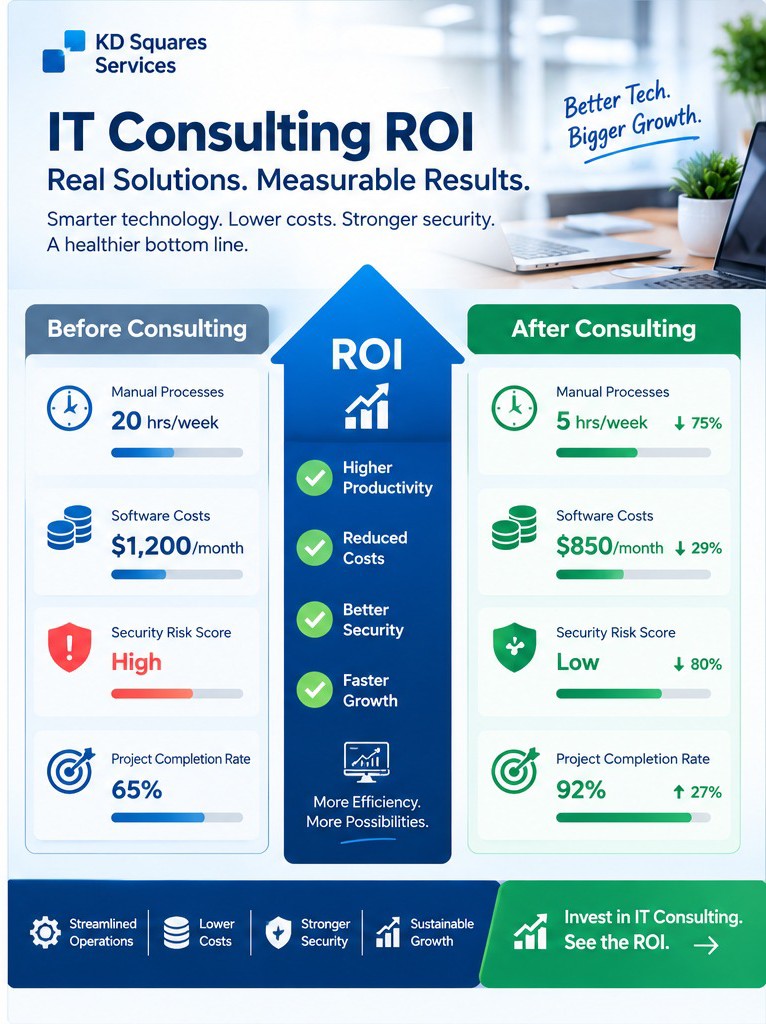
Defining Measurable Outcomes: Reduced Cycle Time, Higher Throughput, and Better Data Security
The biggest mistake businesses make when evaluating consulting ROI is focusing solely on technology metrics.
The true value comes from business outcomes.
Reduced Cycle Time
Cycle time measures how quickly a process moves from start to completion.
Examples include:
Customer onboarding
Purchase approvals
Invoice processing
Order fulfillment
Strategic consulting often shortens these timelines through workflow optimization and automation.
Faster processes directly improve customer satisfaction and operational efficiency.
Higher Throughput
Throughput refers to how much work your organization can complete within a given time period.
When technology barriers are removed:
Employees process more transactions
Sales teams manage more opportunities
Support teams handle more customer requests
Operations teams complete projects faster
This increased productivity creates measurable revenue and growth opportunities.
Better Data Security
The financial impact of stronger cybersecurity extends beyond breach prevention.
Benefits include:
Reduced downtime
Protected customer trust
Lower compliance risks
Enhanced business continuity
Stronger operational resilience
Security improvements are often difficult to quantify until a crisis occurs. However, their value becomes unmistakable when businesses avoid costly disruptions.
Improved Decision-Making
High-quality consulting also improves data visibility.
By integrating systems and refining reporting practices, leadership teams gain access to more accurate information.
Better data leads to:
Smarter investments
Faster decisions
Clearer forecasting
Improved resource allocation
This strategic advantage often becomes one of the most valuable outcomes of consulting engagements.
The KD Squares Approach: High-Tech Capabilities Combined with High-Touch Care
At KD Squares Services, technology consulting isn't just about recommending software or solving technical problems.
It's about understanding each client's business objectives and creating practical solutions that deliver measurable results.
Strategic First, Technical Second
Rather than beginning with technology, the KD Squares approach starts with business goals.
Questions include:
What operational challenges exist?
Where are productivity bottlenecks?
Which manual tasks consume the most time?
What growth objectives are being limited by current systems?
Only after identifying these factors do technology recommendations enter the conversation.
A Focus on Business Automation
Many businesses struggle with disconnected processes that waste time and resources.
KD Squares helps organizations:
Automate repetitive workflows
Eliminate duplicate data entry
Improve operational visibility
Connect critical business systems
Increase team productivity
For businesses looking to hire a business automation consultant, this results-oriented approach ensures every technology initiative supports measurable improvements.
Technology Guidance Without Vendor Bias
One of the advantages of working with an independent consultant is receiving objective recommendations.
Rather than pushing specific products, KD Squares evaluates solutions based on:
Business requirements
Budget constraints
Scalability needs
Integration capabilities
Long-term operational value
This helps businesses avoid costly technology decisions driven by marketing hype rather than actual needs.
Long-Term Partnership and Support
Successful technology transformation is rarely a one-time event.
As businesses evolve, systems, processes, and strategic priorities change.
KD Squares provides ongoing guidance to help clients continually optimize operations, improve efficiency, and maximize the return on every technology investment.
This combination of high-tech expertise and high-touch service creates a consulting experience focused on lasting business growth rather than temporary fixes.
Final Thoughts
The question isn't whether technology impacts your business. It already does.
The real question is whether your technology investments are producing measurable returns.
When businesses delay strategic guidance, they often end up paying for it through wasted software spending, inefficient workflows, security vulnerabilities, and missed growth opportunities.
The strongest SMB tech consultant ROI comes from preventing mistakes before they happen, optimizing existing resources, and ensuring every technology investment contributes directly to business outcomes.
Whether you're evaluating software, improving cybersecurity, automating workflows, or scaling operations, professional IT consulting for small business can provide the expertise needed to move forward with confidence.
Stop Guessing Your Tech Strategy
Partner with KD Squares for Expert IT Consulting.
Discover how the right technology strategy can reduce costs, improve productivity, strengthen security, and position your business for sustainable growth. Contact KD Squares Services today and start turning technology into a competitive advantage.

Join the newsletter read by 1k+ No-Code Professionals
© 2025 KD Squares. All rights reserved.
Ready to Stop Fighting Your Tech?
Join 100+ small businesses who’ve automated their chaos and started scaling. Get your dedicated systems engineer today and finally make your tools work together.

COMPANY
LEGAL
FOLLOW US


+234 9037 348 604
Plot 100 Avhua Estate,Army Range Eneke-Igwurita, Port Harcourt Rivers 500102
Copyright 2026. KD Squares LTD. All Rights Reserved.

Contact us


+234 9037 348 604
Plot 100 Avhua Estate, Army Range, Eneka-Igwuruta, Port Harcourt, Rivers State
© 2024 KD Squares. All rights reserved